
You can also find my articles on Google Scholar.
My research seeks to uncover the principles by which neural systems are built, in order to move from understanding brains to designing biological and artificial circuits. I study how genes and development give rise to functional connectivity, how evolution shapes wiring to support innate behaviors and learning, and how emerging connectomes and transcriptomes can reveal the organizing rules that link these scales.
This work has been guided by a broader conviction, one I articulated in a JNeuro TechSights, that understanding the brain requires integrating cell identity, connectivity, and function across scales. I now see that neural development is more than the assembly of brain structure: it is the installation of structured priors for lifelong behavior and learning.
Molecular rules of circuit assembly.

I began my graduate work by asking: where and how is neuronal connectivity encoded? In a Neuron paper, I started from the hypothesis that the genetic identity of neurons guides synapse and gap junction formation, and derived that this in turn generates biclique motifs. In PNAS, I developed a theoretical framework — the Spatial Connectome Model — to extract the genetic determinants of connectivity from three data sources: the connectome, the transcriptome, and the contactome (neuronal physical contacts). When applied to the gap junction network of C. elegans, we predicted 19 candidate interactions among innexin proteins, 5 of which were confirmed experimentally. More broadly, this work showed that the molecular logic of connectivity can be treated as an inference problem, linking large-scale anatomical maps to mechanistic hypotheses about circuit formation.
Selected talks
- Wiring the Brain: An Intersection of Genetics and Physics. Yale University. 6.5.2024. Invited Speaker.
- Nature over Nurture: Inferring genetic priors of connectivity. Biozentrum, Basel. 12.6.2022. Invited Speaker.
- Genetically Driven Wiring of the Connectome. Neuroscience Meets Network Science Kavli Salon, Los Angeles. 10.4.2022. Invited Speaker.
- Wiring the Brain: An Intersection of Genetics and Physics. Notre Dame Condensed Matter Seminar. 12.9.2021. Invited Speaker.
- From Genes to Connectome: Guiding the Search for Developmental Principles. Institute of Experimental Medicine, Budapest. 10.7.2020. Invited Speaker.
- Wiring the Brain: An Intersection of Genetics and Physics. Wigner Research Center for Physics, Budapest. 12.15.2020. Invited Speaker.
- Genetically Driven Wiring of the C. elegans Connectome. CIRCS Seminar, Northeastern University. 10.30.2018. Invited Speaker.
Developmental priors for neural computation.
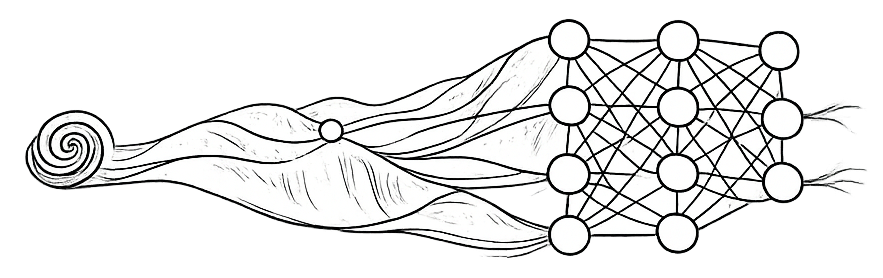
Inspired by these compact molecular rules underlying biological connectivity, I next asked whether genetic encoding could serve as a general principle for network construction. In Scientific Reports, I defined a generative network model that uses simple heuristics to build scale-free and feed-forward topologies out of biclique motifs. Building on this idea, I proposed the Genetic neuroEvolution Model (GEM, Nature Communications), in which artificial neural network weights are not optimized directly, but instead emerge from learned compatibility rules between neurons, inspired by the developmental wiring models from my earlier Neuron and PNAS papers. Rather than improving task fitness by updating individual weights, GEM updates the neurons’ wiring rules, mirroring evolutionary selection on developmental programs. We find that GEM (1) provides sufficient representational power for strong performance on machine learning benchmarks while also compressing parameter counts, and (2) acts as an effective regularizer in meta-learning settings, favoring simpler and more stable circuit solutions. Together, these two papers crystallized a theme that has remained central to my research: development can be understood not just as a biological process, but as a source of structured priors that support efficient computation.
Selected talks
- Nature over Nurture: Neural Networks, Biological and Artificial, are Primed for Behavior. Varol Lab. 3.4.2026. Invited Speaker.
- Nature over Nurture: How Complex Behaviors Emerge from Neurodevelopmental Priors. University of Stuttgart. 11.3.2025. Invited Speaker.
- Complex Computations from Developmental Priors. Physical Networks Satellite, NetSci, Quebec City. 6.17.2024. Invited Speaker.
- Lectures on Brain Development and Evolution of Intelligent Systems. CapoCaccia Workshops toward Neuromorphic Intelligence, Sardinia. 4.28–5.11.2024. Invited Speaker.
- Complex Computations from Developmental Priors. Center for Living Systems, University of Chicago. 1.22.2024. Invited Speaker.
- Nature over Nurture: How Complex Computations Emerge from Developmental Priors. Rockefeller University. 1.11.2024. Invited Speaker.
Experimental validation of the assembly of functional circuits.
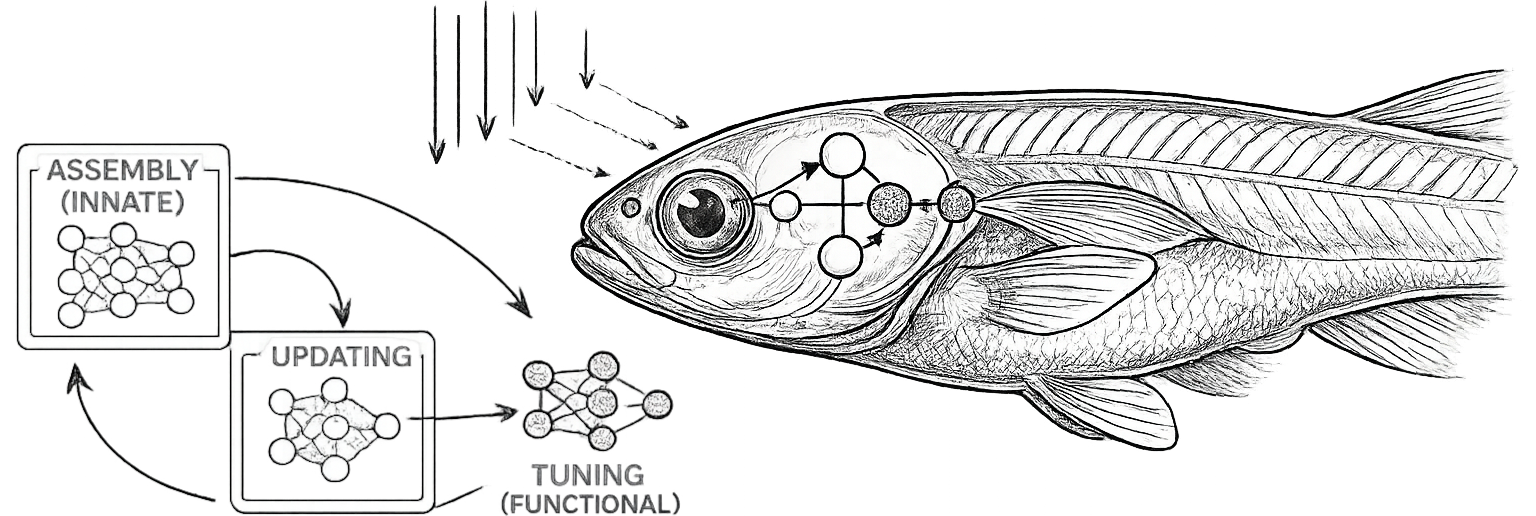
I next sought to test my computational ideas experimentally, by asking whether complex behavior can emerge from developmental wiring alone. In Nature Communications, I showed that the zebrafish optomotor response can mature even when neural activity is pharmacologically silenced throughout development. After washout of the anesthetic, animals still performed visually guided behavior with high accuracy, and brain-wide imaging revealed that the underlying neural populations came online already tuned, without requiring activity-dependent refinement. Thus, complex sensory-guided behavior can be assembled by activity-independent developmental mechanisms. I later formalized this view in Nature Reviews Neuroscience, proposing that circuit formation reflects three interacting systems: assembly, in which genetically guided programs establish core circuitry; updating, where salient experiences rapidly modify synapses; and tuning, in which ongoing plasticity stabilizes and fine-tunes networks. This summarizes the implications of my experimental findings: rather than treating learning and plasticity as the primary architects of neural function, many core competencies may first emerge through innate developmental programs, upon which later experience acts to update and refine.
Selected talks
- Nature over Nurture: How Complex Behaviors Emerge in the Absence of Activity. WorldWideNeuRise. 4.5.2023. Invited Speaker.
- Nature over Nurture: Functional circuits emerge in the absence of activity. FMI, Basel. 12.9.2022. Invited Speaker.
- Nature over Nurture: Functional circuits emerge in the absence of activity. Institute of Neuroinformatics, Zurich. 12.8.2022. Invited Speaker.
- Nature over Nurture: Functional circuits emerge in the absence of activity. MRC Laboratory of Molecular Biology, Cambridge. 11.8.2022. Invited Speaker.
Organizational principles of connectome architecture.
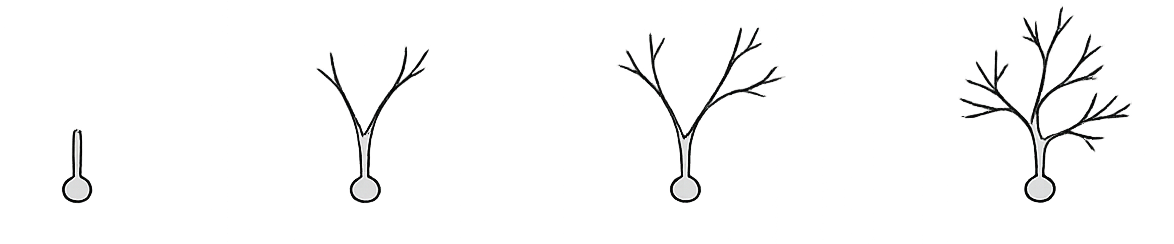
As neuronal-level maps became available, I returned to the question of how brain-wide connectivity is organized. Collating eight connectomes across five species, I found that canonical network-science models do not capture brain architecture: neuronal degree and connection strength were consistently better approximated by lognormals than by random or scale-free distributions. To address this inconsistency, we reframed the brain as a physical network of spatially extended neurons, thereby providing a mechanistic model: stochastic multiplicative growth of arbor length provides a common developmental basis for the observed distributions of neuron length and degree. This framework links morphology, connectivity, and network organization in a unified quantitative theory, generating empirically falsifiable relationships among neuronal properties.
Selected talks
- Physical Network Constraints Define the Lognormal Architecture of the Brain's Connectome. Flywire Community Day, Princeton University. 9.15.2025. Invited Speaker.
- Physical Network Constraints Define the Lognormal Architecture of the Brain's Connectome. Networks Seminar, Oxford University. 2.11.2025. Invited Speaker.
Agentic AI for scientific discovery.
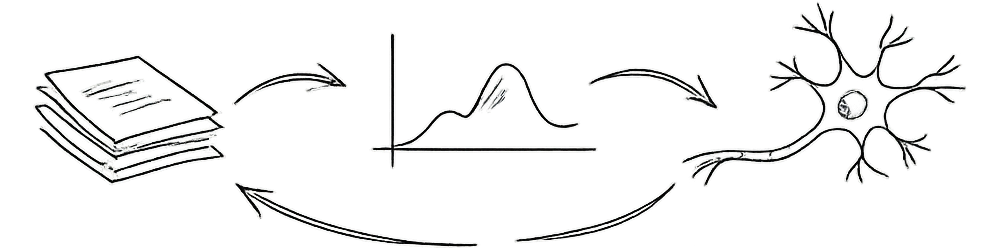
As a FutureHouse AI-for-Science Fellow, I am working on the design and evaluation of an AI Scientist (Kosmos) that integrates hypothesis-guided literature search and data analysis into iterative scientific workflows. This gave me unusual firsthand experience with a new methodological frontier: building AI systems that do not merely summarize knowledge, but produce mechanistic insight. In evaluating Kosmos on connectomics, I found that it could not only reproduce the central empirical findings of my preprint, but also recovered the underlying interpretation. I now see agentic systems as essential partners in extracting organizing principles from large-scale brain datasets, and am continuing to pioneer AI-assisted theory-building as a core methodology for connectomic discovery.
Selected talks
- SciHarness: Agentic AI for Scientific Workflows. Cambridge University AwAI Day. 3.18.2026. Invited Speaker.